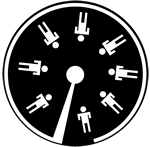
As human beings, we really don’t understand death, either its transformative power or its nonfinal nature. When I say that death has a transformative power, I’m referring to that aspect of death – to that kind of death – which is not the end of the body. Rather, it’s the death we each need to experience while we’re still alive here on the planet. It’s death as a way of being. It’s the death of the old self and its old ways.
To truly live is to experience each moment. To experience each moment is to be born into each moment with a new skin. Yet to be born prefigures a death. That which is born must die. To be born in each moment means to die in each moment, too. And that’s why, from the human perspective, it’s necessary to die continuously. Humans tend not to understand this since we live in time, and time prevents us from living in the now. We see ourselves as experiencing one birth – at the beginning of our lives – and one death – at the end of our lives. We celebrate this birth, and mourn this death. More than anything, we fear this biological end, for it means the final death of the ego.
Yet by believing in the reality of time and living in it, we experience another kind of death – a perpetual death of the spirit. While we believe that we live in time, we experience the absence of awareness. To live in the past displaces the now. And we can always and only be fully aware in this moment. To live in the future also dislocates the present. This kind of death is a spiritual one, in which the spirit lacks awareness because it’s taken into dreams of past or future.
The ego dies when we live in the now, in the instant when awareness is total and the soul awakes. When we live in the present moment, the operations of the ego are temporarily suspended, though not ultimately terminated. The ego experiences itself as past-present-future. It sees itself as the continuity of time, living within the flow of time. It spends the vast majority of its moments in the past or in the future, and can only experience the now if it’s shocked into it through various devices, things like drugs, sex, jumping out an airplane, being confronted with death or a facsimile of death, like a good drama. We can also be drawn into the now by spending time with another being – like a puppy or a child – which itself is very relaxed into the present moment. Otherwise, the ego defaults to its memories of the past or its projection about the future.
The ego’s faculties of memory and prediction are highly suspect. Its ‘time travel’ into past and future states are really just distortions, fantasies. We seldom remember events accurately, and our predictions about the future are usually pretty off. Yet without time, the ego ceases to be. So, it spends most of its time wasting time in either a fantasy of the past or a fantasy of the future. We need to die to these states. If we are to truly live, this is the kind of death to which we need to aspire.
When we live in the now, we constantly discard past versions of the self which are no longer real, since the past is no longer a reality. This shedding of the past is the kind of death which makes possible continuous renewal. It’s a transformational death that makes true living possible. Yet we don’t often see this as being a worthwhile goal, for we’re born into time, and the mind has conditioned itself to hold time as the reality in which we operate.
Now, what about bodily death? This is the kind of death that the ego really fears, since it represents the permanent end of the ego, of the little self. At least in the spiritual rebirth outside of time described above, the ego can (and does) pull us back into time and re-attain its status quo existence in temporal reality. But when the body dies, the ego dies along with it. At least from our perspective as individual humans, that’s the way the ego sees it.
And so, what it will do is seek another body. It will pursue reincorporation into another hunk of matter to postpone its own demise. Certain bardo teachings from Eastern wisdom traditions as well as from ancient Greece hold that once its body dies, the ego will seek to reincarnate, and that it can be difficult to avoid this rebirth. If this is so, then this endless cycle of birth and death is perhaps a prime tragedy of human existence. It makes cyclic existence possible, and even necessary. Through it, we become slaves to time, to birth and death. Some philosophers have ascribed this endless cycle to an automated process called the Eternal Return. It’s portrayed as a doomed perpetuity of human birth, suffering and death. In this scheme, we’re destined by fate to die, and then drink from the waters of forgetfulness, only to return to human form again and again, repeating episodes of suffering. According to this grim view, human choice is absent. It’s projected onto fate, or perhaps karma. The endless wheel of existence is beyond our destiny to change, since we’re slave to our past actions and thoughts.
If you’re religiously or spiritually inclined, you may ascribe this incorporation into bodily form to a God which created us. If you’re more oriented to Eastern thought, you may call it karma. If you’re science-minded, you may attribute this birth into material form to random, mechanistic processes. This randomness eventually gave rise to a probability which gave rise to us.
Whatever the form our beliefs take, few of us conclude that we have chosen our births, our bodies, our individual selves, our very human lives as carriers of our experience. It seems to be a minority opinion. For if we have chosen to be born, then we have also chosen to die. That which is born in a vessel must let that vessel perish.
As to the first form of death discussed – the death experienced when we forfeit the aliveness of the moment and escape into the past or the future – we choose. We can live in time, or we can live in the endless present, which is a form of eternity. For if time is suspended, by default, nothing else can surround us but timelessness.
As to the second kind of death – biological death – it seems as if we have no ultimate choice. From this side of the veil, the human side, once we’re born, we must die. In science, this is called entropy, the tendency of organized systems toward breakdown and dissolution. Yet maybe we shouldn’t take such a dim view of the Eternal Return and its cycle of being spit back into the wheel of time. If we choose whether we live in time – in past, present or future – within the brief span of our human lives, then we may also choose whether we live in time on the plane of the soul. Perhaps it’s we who choose to be born in time. And if it’s our choice to be born, it softens the blow of death. If it’s our choice to be born, then perhaps we can choose not to be born, but to become aware of a birthless, deathless existence. This is the essence of the teachings of Tibetan Buddhism.
Now that we are here, we see only through the eyes of our human selves, and perceive lives that end always in time. We cannot see that perhaps no matter the species of death we behold, if we hold it rightly, death is simply the ultimate transfiguration. In death, the shadows of matter and time dissolve in a light which in its ceaseless love shines on us always.
© 2025 by Michael C. Just